
Received a Business Demand Letter? A Decision Checklist Before You Respond
Received a Business Demand Letter? A Decision Checklist Before You Respond: business and legal information.
A demand letter can arrive from a former partner, customer, employee, supplier, competitor or opposing counsel. Some demand letters describe serious potential claims; others contain factual errors or proposals that do not match the underlying contract. The most damaging reaction is often to treat the letter as either an automatic defeat or something to ignore. This guide helps business owners organize the facts and deadlines before crafting a careful response.
Reader’s roadmap: The following sections identify the business problem, practical records to gather, possible options and caution points. They are general educational guidance and cannot determine the legal outcome of an individual matter.
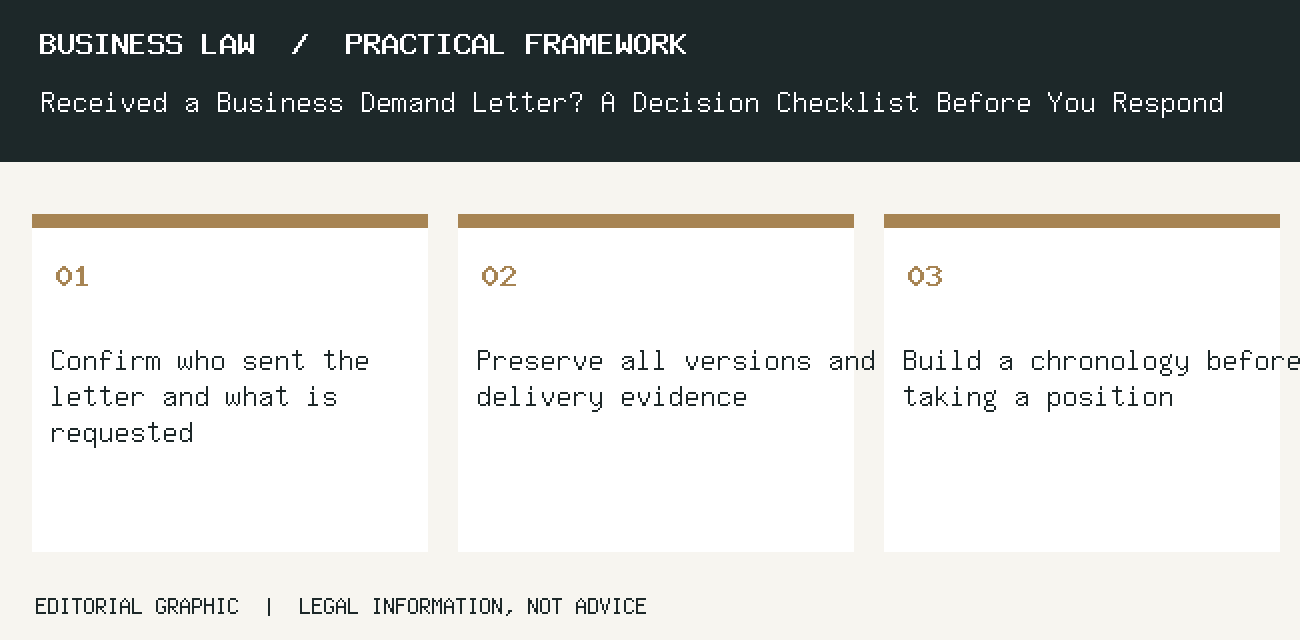
Confirm who sent the letter and what is requested
A demand may combine multiple allegations, deadlines, requests for documents and settlement proposals in one document. Consider what a reviewer unfamiliar with the relationship would need to verify this point. Identify the person responsible, the operative document, the relevant date and the practical impact. If the answer is uncertain, record precisely which additional fact or document could resolve it.
Identify the sender, represented parties, asserted legal basis, requested payment or action, and response deadline. A governing document should be read together with the later record of conduct, without assuming that conduct always alters the written rule. Collect executed agreements and amendments first, then compare them against emails, approvals and the actual flow of money. A disciplined comparison is more useful than selecting one document that supports a preferred position.
A vendor letter might request unpaid invoices and also demand that confidential files be returned. In a real disagreement, ask which document establishes the underlying obligation, who had authority to act, whether the timeline is agreed, and how a neutral third party could verify the claimed effect. Preserve any competing explanation alongside the supporting evidence.
Do not assume the sender’s characterization establishes liability or that every date is a statutory deadline. A useful next step is to identify the decision owner and deadline while keeping factual assertions carefully documented. Commercial urgency can justify attention, but it does not eliminate contractual requirements, confidentiality duties or the need to understand likely consequences.
Preserve all versions and delivery evidence
Envelope tracking, email headers, attachments and subsequent corrections may matter in interpreting timing and scope. The written record should separate an original obligation from a later negotiation. That difference matters when deciding whether a requested action is mandatory, optional or still disputed. Do not quietly replace an earlier version; label amendments and preserve the chronology.
Store the original message, attachments and delivery details in a controlled location with a clear file name. The commercial consequence can be larger than the disputed invoice. Delayed decisions may affect customers, staff, confidential information, financing or vendor relationships. List those effects separately from legal damages; they may shape negotiation priorities without automatically becoming amounts recoverable in court.
A notice provision may specify a postal address rather than the everyday project manager’s email. Preserve any competing explanation alongside the supporting evidence.
Avoid replying from several personal accounts or accidentally forwarding privileged analysis outside the team.
Build a chronology before taking a position
Business disputes often look different when the full sequence of agreement, performance, complaint and communication is visible. Use a short decision log rather than relying on scattered recollections. The log can identify the issue, available options, responsible person, evidence and next date for review. It gives management continuity when several people are involved.
Create a factual timeline with sources linked to each material event and mark unresolved dates. A practical review should explain what is established, what is merely alleged and what evidence would change the assessment. Create a working table with columns for the proposition, source, competing explanation and unresolved question. This makes legal advice and business planning more focused.
A cancellation allegation may omit weeks of prior complaints or a documented extension of time. Preserve any competing explanation alongside the supporting evidence.
Do not fill evidence gaps with assumptions simply to produce a persuasive one-page account.
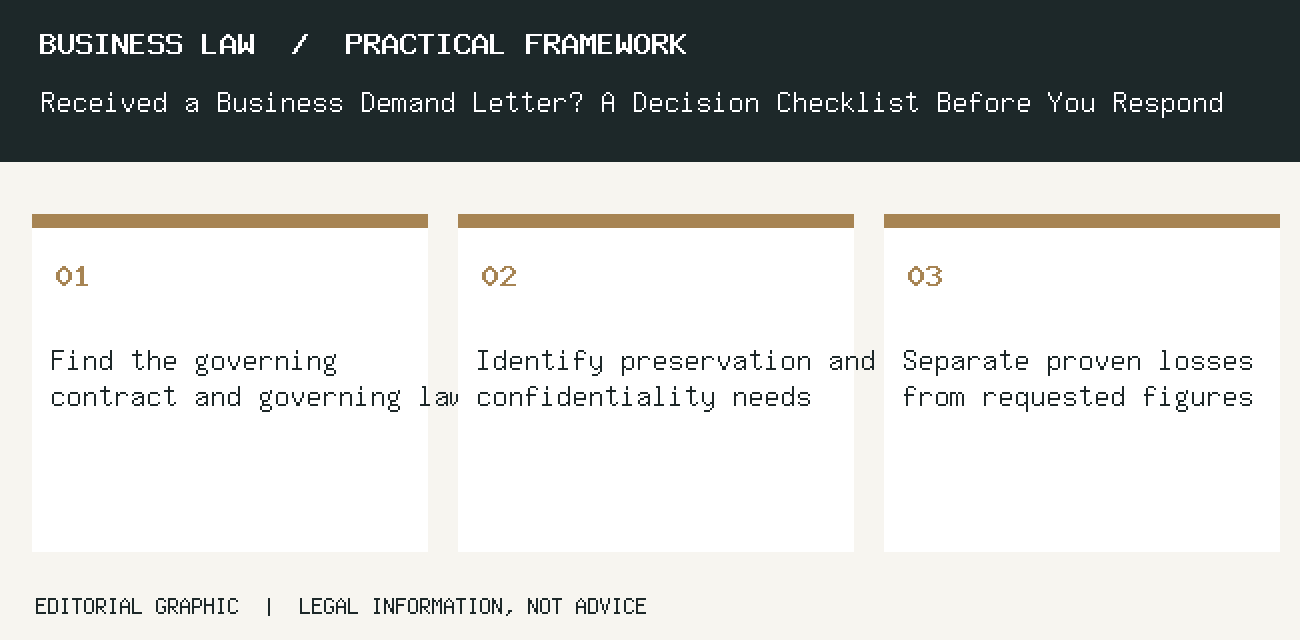
Find the governing contract and governing law
Written terms may address indemnity, limitation, notice, remedies, arbitration, venue and attorneys’ fees. The relevant business question is how this affects performance, money, control or relationships, and which facts support that conclusion. A focused response is usually easier to evaluate than one that mixes every grievance into a single demand.
Locate the signed agreement, amendments, purchase orders and relevant incorporated policies. Business owners may prefer a fast answer, but decisions such as termination, public accusations, account lockouts or release signatures can be difficult to reverse. Identify the governing approval and notice rules before acting. Meanwhile, assign immediate operational safeguards that do not require taking an unsupported legal position.
A sales order could incorporate service terms that include an escalation process absent from the email demand. Preserve any competing explanation alongside the supporting evidence.
Do not rely on a downloaded template that looks similar but was not actually executed.
Identify preservation and confidentiality needs
Litigation risk can make communications, financial records, devices and collaboration platforms potentially relevant.
Coordinate a reasonable document-preservation plan and restrict unnecessary commentary in shared channels. Documents should be maintained in a way that preserves context. Keep original files, unedited email chains and relevant metadata where feasible. A neat presentation copy is useful, but it should trace back to authentic source material and make assumptions clear.
A project chat may contain operational decisions even though the main contract sits in the legal department. Preserve any competing explanation alongside the supporting evidence.
Avoid deleting unfavorable records or instructing employees to clean up histories after a dispute becomes foreseeable.
Separate proven losses from requested figures
A demand may include principal amounts, penalties, fees, interest, lost profits or speculative values.
Reconcile each figure to contracts, invoices, payment records, assumptions and claimed legal entitlement. Risk analysis is not the same as predicting a verdict. The available claims, defenses, documents, costs, deadlines and likely business disruption should be evaluated together. A discussion with counsel can prioritize the next decision even when a final legal outcome cannot yet be known.
A late-payment invoice and a projected long-term revenue loss require different supporting documentation. Preserve any competing explanation alongside the supporting evidence.
Do not accept or reject a lump-sum number without understanding its components.
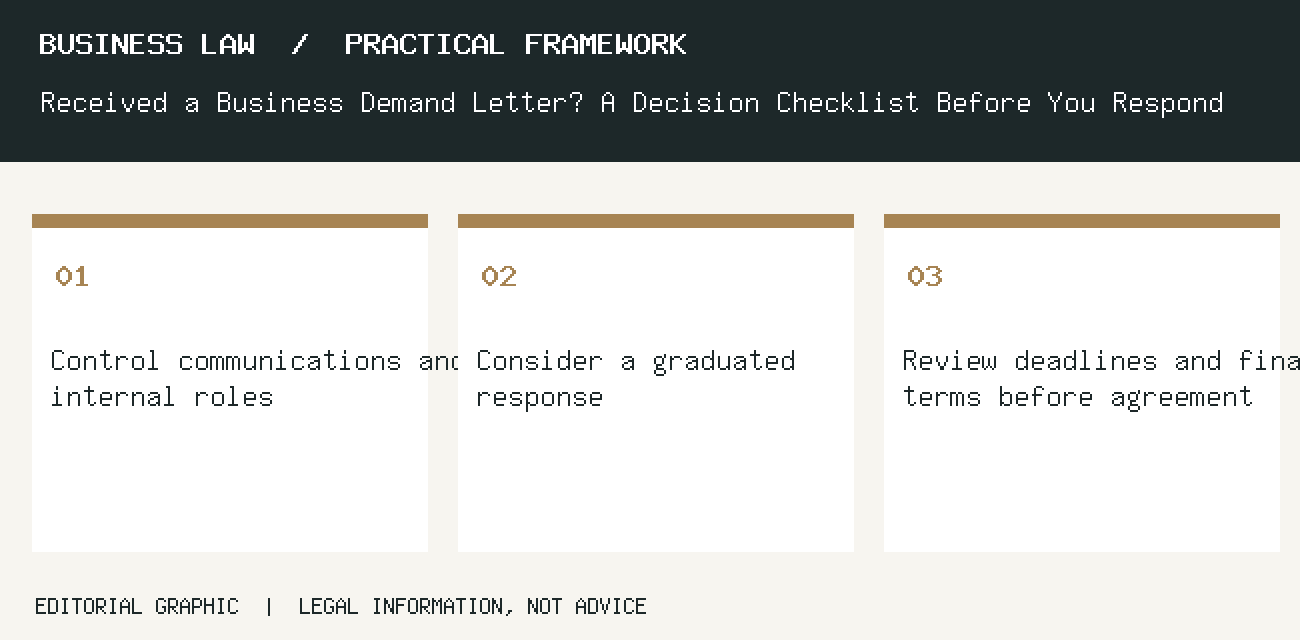
Control communications and internal roles
Conflicting responses from sales, operations, finance and management can create confusion or inconsistent representations.
Designate an internal point person and identify who will review factual statements and settlement proposals. Contractual notice processes matter because a sound commercial complaint may still face avoidable procedural objections. Check addresses, recipients, delivery methods and response periods in the actual operative agreement. Record when the communication was sent and received.
An account manager trying to preserve the relationship may inadvertently make a promise management cannot fulfill. Preserve any competing explanation alongside the supporting evidence.
Do not assume a marked ‘without prejudice’ email has the same effect in every jurisdiction or context.
Consider a graduated response
Depending on the facts, options may include acknowledging receipt, requesting details, proposing discussion or preparing a substantive legal response.
Match the response to urgency, legal risk, preservation needs and the credibility of available evidence. An internal owner for each issue helps ensure that requests for information do not disappear between departments. Financial questions may belong with accounting, system-access questions with operations, and governance issues with responsible leadership. Consolidate the results into a single decision record.
An unclear damages calculation might call for a focused request rather than an immediate, broad denial. Preserve any competing explanation alongside the supporting evidence.
Avoid threatening countersuits reflexively, particularly before evaluating exposure and business objectives.
Review deadlines and final terms before agreement
Settlement and release language can resolve more or less than the immediate demand, and procedural deadlines can continue running.
Have counsel review proposed releases, confidentiality, payment triggers, dismissal steps and applicable time limits. Before resolving a dispute, determine what completion will mean: who acts, by when, what documents or payments change hands, and how both parties verify performance. Ambiguous closing terms are a common source of renewed disagreement.
A settlement that resolves one invoice might inadvertently waive a distinct warranty dispute if phrased too broadly. Preserve any competing explanation alongside the supporting evidence.
Do not rely on an informal negotiation to suspend a court, arbitration or contractual deadline.
A nine-point working checklist
- Confirm who sent the letter and what is requested: Identify the sender, represented parties, asserted legal basis, requested payment or action, and response deadline.
- Preserve all versions and delivery evidence: Store the original message, attachments and delivery details in a controlled location with a clear file name.
- Build a chronology before taking a position: Create a factual timeline with sources linked to each material event and mark unresolved dates.
- Find the governing contract and governing law: Locate the signed agreement, amendments, purchase orders and relevant incorporated policies.
- Identify preservation and confidentiality needs: Coordinate a reasonable document-preservation plan and restrict unnecessary commentary in shared channels.
- Separate proven losses from requested figures: Reconcile each figure to contracts, invoices, payment records, assumptions and claimed legal entitlement.
- Control communications and internal roles: Designate an internal point person and identify who will review factual statements and settlement proposals.
- Consider a graduated response: Match the response to urgency, legal risk, preservation needs and the credibility of available evidence.
- Review deadlines and final terms before agreement: Have counsel review proposed releases, confidentiality, payment triggers, dismissal steps and applicable time limits.

Common questions
Must every demand letter receive a response?
There is no universal answer. The risk, formal status and applicable requirements should be reviewed promptly. The correct response depends on the actual agreement, evidence, relevant law and procedural deadlines; tailored professional advice is appropriate before acting.
Is a demand letter the same as a lawsuit?
No. A demand and a filed legal proceeding are different, though each can create important decisions.
Can a business negotiate without admitting liability?
Parties can discuss resolution positions, but communication and settlement terms need careful review.
Should the entire staff receive the letter?
Share only with those who need it for preservation, fact gathering and response planning.
Explore related legal services
- Business and corporate counsel
- Contract review and outside general counsel
- Commercial dispute resolution
- Contact AW Business Law
Official reference: California Courts civil lawsuit preparation.
This is general legal information, not legal advice, a promise of a particular outcome or an attorney-client engagement. The right approach depends on your business, contracts and applicable law.
Get clarity on your next business decision
Contracts, ownership decisions and commercial disagreements deserve careful, practical legal attention. Speak with counsel about your situation.