
When a Business Vendor Fails to Deliver: A Contract Response Playbook
When a Business Vendor Fails to Deliver: A Contract Response Playbook: business and legal information.
A missed vendor deadline can be inconvenient; a critical service outage, incomplete implementation, defective deliverable or broken supply commitment can put revenue and customer relationships at risk. Businesses often react by withholding payment or issuing a cancellation before checking what their agreement actually provides. A more useful response links the contractual promise, actual performance, business impact and available options. This guide outlines an evidence-led process for commercial vendor disputes.
Reader’s roadmap: The following sections identify the business problem, practical records to gather, possible options and caution points. They are general educational guidance and cannot determine the legal outcome of an individual matter.
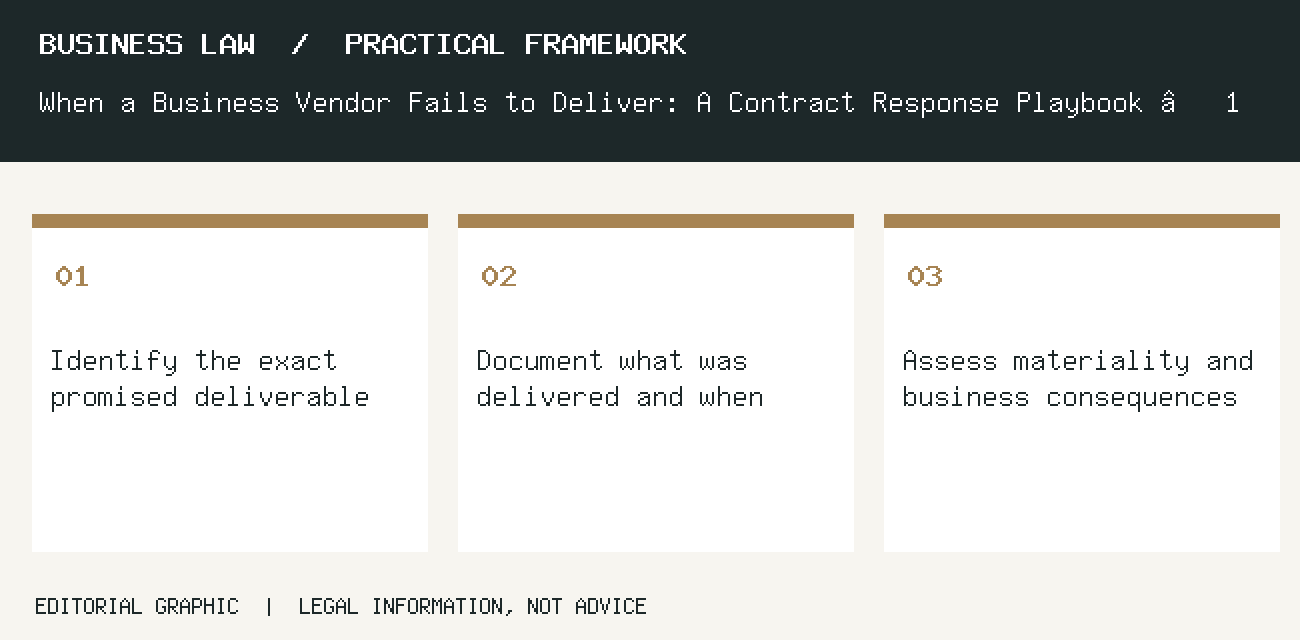
Identify the exact promised deliverable
Statements made in sales calls can differ from the obligations contained in a signed agreement and statement of work. Consider what a reviewer unfamiliar with the relationship would need to verify this point. Identify the person responsible, the operative document, the relevant date and the practical impact. If the answer is uncertain, record precisely which additional fact or document could resolve it.
Compare deliverables, milestones, measurable service levels, acceptance criteria and incorporated exhibits. A governing document should be read together with the later record of conduct, without assuming that conduct always alters the written rule. Collect executed agreements and amendments first, then compare them against emails, approvals and the actual flow of money. A disciplined comparison is more useful than selecting one document that supports a preferred position.
A software implementation contract may require a functioning integration, not merely a demonstration of a prototype. In a real disagreement, ask which document establishes the underlying obligation, who had authority to act, whether the timeline is agreed, and how a neutral third party could verify the claimed effect. Preserve any competing explanation alongside the supporting evidence.
Avoid using an aspirational marketing claim as the sole proof of a contractual obligation. A useful next step is to identify the decision owner and deadline while keeping factual assertions carefully documented. Commercial urgency can justify attention, but it does not eliminate contractual requirements, confidentiality duties or the need to understand likely consequences.
Document what was delivered and when
The parties may disagree whether performance was late, incomplete, rejected or accepted with reservations. The written record should separate an original obligation from a later negotiation. That difference matters when deciding whether a requested action is mandatory, optional or still disputed. Do not quietly replace an earlier version; label amendments and preserve the chronology.
Create a dated ledger of releases, tickets, emails, delivery receipts, acceptance tests and change requests. The commercial consequence can be larger than the disputed invoice. Delayed decisions may affect customers, staff, confidential information, financing or vendor relationships. List those effects separately from legal damages; they may shape negotiation priorities without automatically becoming amounts recoverable in court.
A vendor may point to a deployment date while the customer points to failed user acceptance testing. Preserve any competing explanation alongside the supporting evidence.
Do not overwrite failed test results when rerunning a test; preserve both versions.
Assess materiality and business consequences
A minor deviation and a failure that defeats the transaction’s core purpose can call for different responses. Use a short decision log rather than relying on scattered recollections. The log can identify the issue, available options, responsible person, evidence and next date for review. It gives management continuity when several people are involved.
Identify affected workflows, downtime, additional costs, workarounds, customer impacts and the remaining useful value. A practical review should explain what is established, what is merely alleged and what evidence would change the assessment. Create a working table with columns for the proposition, source, competing explanation and unresolved question. This makes legal advice and business planning more focused.
A late monthly report may be manageable; failure of a payment gateway during a launch can present different operational exposure. Preserve any competing explanation alongside the supporting evidence.
Do not inflate losses through estimates that cannot be reconciled to actual business records.
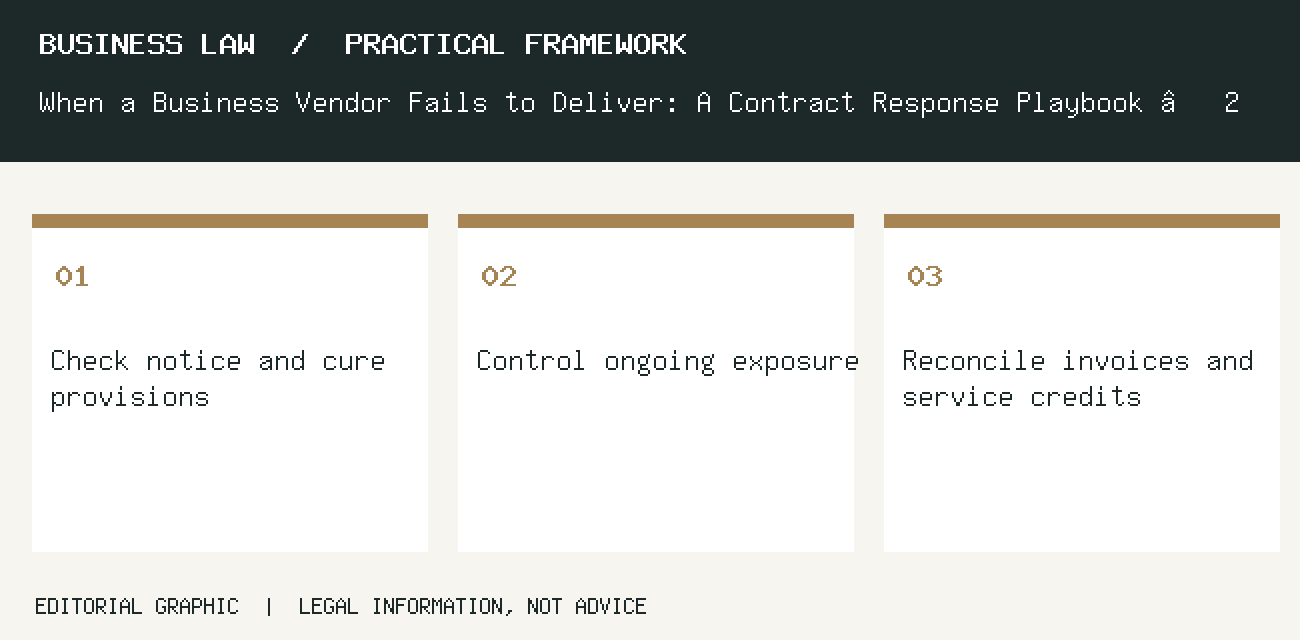
Check notice and cure provisions
Contracts often define how a breach must be reported and whether the vendor has time to correct it. The relevant business question is how this affects performance, money, control or relationships, and which facts support that conclusion. A focused response is usually easier to evaluate than one that mixes every grievance into a single demand.
Record addresses, email rules, notification triggers, cure periods, escalation contacts and the evidence for delivery. Business owners may prefer a fast answer, but decisions such as termination, public accusations, account lockouts or release signatures can be difficult to reverse. Identify the governing approval and notice rules before acting. Meanwhile, assign immediate operational safeguards that do not require taking an unsupported legal position.
A complaint submitted through ordinary support may not satisfy a formal notice address in the master agreement. Preserve any competing explanation alongside the supporting evidence.
Avoid declaring termination while overlooking a required cure procedure without first obtaining advice.
Control ongoing exposure
Continuing to rely on a failing vendor may increase risk, while abrupt termination can interrupt essential operations.
Plan backups, data exports, temporary workarounds, access controls and alternate suppliers within lawful bounds. Documents should be maintained in a way that preserves context. Keep original files, unedited email chains and relevant metadata where feasible. A neat presentation copy is useful, but it should trace back to authentic source material and make assumptions clear.
A company can prepare transition documentation while the parties are still discussing a cure. Preserve any competing explanation alongside the supporting evidence.
Do not disable systems or seize accounts in ways that create independent security or contractual problems.
Reconcile invoices and service credits
Financial disagreements become more precise when each invoice is mapped to accepted work and available credits.
Separate undisputed charges, challenged items, contract credits, prepaid fees and third-party expenses. Risk analysis is not the same as predicting a verdict. The available claims, defenses, documents, costs, deadlines and likely business disruption should be evaluated together. A discussion with counsel can prioritize the next decision even when a final legal outcome cannot yet be known.
A customer might owe for accepted phases while disputing payment for an incomplete integration. Preserve any competing explanation alongside the supporting evidence.
Avoid treating every missed service target as an automatic right to refuse all future invoices.
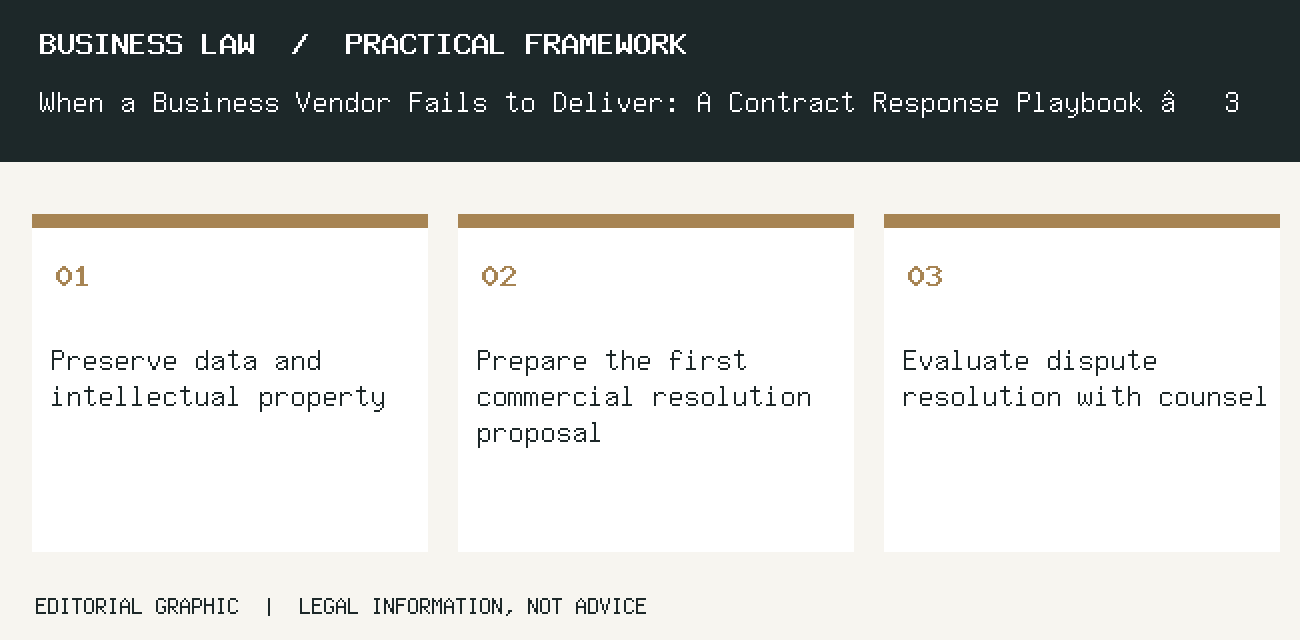
Preserve data and intellectual property
The business may need access to data, configuration, source materials or customer records after a vendor relationship ends.
Review data-export rights, confidentiality, IP ownership, sublicenses, backups and deletion commitments. Contractual notice processes matter because a sound commercial complaint may still face avoidable procedural objections. Check addresses, recipients, delivery methods and response periods in the actual operative agreement. Record when the communication was sent and received.
An agency-created website may depend on a licensed plugin or external hosting account not owned by the customer. Preserve any competing explanation alongside the supporting evidence.
Do not assume possession of a password proves legal ownership of every associated asset.
Prepare the first commercial resolution proposal
A specific request for performance, refund, credit or transition support often communicates more clearly than accusations.
Describe the contract provision, dated failure, requested cure, evidence and reasonable business rationale. An internal owner for each issue helps ensure that requests for information do not disappear between departments. Financial questions may belong with accounting, system-access questions with operations, and governance issues with responsible leadership. Consolidate the results into a single decision record.
The parties may settle a disagreement through staged milestones and additional verification rather than immediate litigation. Preserve any competing explanation alongside the supporting evidence.
Avoid offering a final release casually or making demands inconsistent with contractual dispute procedures.
Evaluate dispute resolution with counsel
Some agreements direct parties to arbitration, mediation or a particular court and include fee allocation or limitation clauses.
Provide the agreement, notices, impact calculations, vendor responses and any looming deadlines for a targeted review. Before resolving a dispute, determine what completion will mean: who acts, by when, what documents or payments change hands, and how both parties verify performance. Ambiguous closing terms are a common source of renewed disagreement.
The contract’s liability cap may influence a sensible settlement range even where business losses are substantial. Preserve any competing explanation alongside the supporting evidence.
Do not assume the strongest commercial grievance automatically produces every form of legal relief.
A nine-point working checklist
- Identify the exact promised deliverable: Compare deliverables, milestones, measurable service levels, acceptance criteria and incorporated exhibits.
- Document what was delivered and when: Create a dated ledger of releases, tickets, emails, delivery receipts, acceptance tests and change requests.
- Assess materiality and business consequences: Identify affected workflows, downtime, additional costs, workarounds, customer impacts and the remaining useful value.
- Check notice and cure provisions: Record addresses, email rules, notification triggers, cure periods, escalation contacts and the evidence for delivery.
- Control ongoing exposure: Plan backups, data exports, temporary workarounds, access controls and alternate suppliers within lawful bounds.
- Reconcile invoices and service credits: Separate undisputed charges, challenged items, contract credits, prepaid fees and third-party expenses.
- Preserve data and intellectual property: Review data-export rights, confidentiality, IP ownership, sublicenses, backups and deletion commitments.
- Prepare the first commercial resolution proposal: Describe the contract provision, dated failure, requested cure, evidence and reasonable business rationale.
- Evaluate dispute resolution with counsel: Provide the agreement, notices, impact calculations, vendor responses and any looming deadlines for a targeted review.

Common questions
Can a business stop paying a vendor after a breach?
The answer depends on the contract, facts and governing law; distinguish disputed and undisputed charges. The correct response depends on the actual agreement, evidence, relevant law and procedural deadlines; tailored professional advice is appropriate before acting.
Do all failures justify termination?
No. Materiality, notice provisions and cure rights can change the answer.
Should data be exported before a dispute escalates?
Plan lawful, contract-compliant preservation and transition promptly to reduce operational risk.
What makes a useful demand letter?
Specific promises, documented failures, a clear request and compliance with the agreement’s notice rules.
Explore related legal services
- Business and corporate counsel
- Contract review and outside general counsel
- Commercial dispute resolution
- Contact AW Business Law
Official reference: California Courts contract breach guide.
This is general legal information, not legal advice, a promise of a particular outcome or an attorney-client engagement. The right approach depends on your business, contracts and applicable law.
Get clarity on your next business decision
Contracts, ownership decisions and commercial disagreements deserve careful, practical legal attention. Speak with counsel about your situation.