
Business Partner Deadlock: A Practical Guide to Decisions, Records, and Resolution
Business Partner Deadlock: A Practical Guide to Decisions, Records, and Resolution: business and legal information.
A disagreement between business partners can quietly become an operational crisis. The company still has customers, employees, payroll and contracts, but the owners may no longer agree about spending, leadership, growth or exit. A business deadlock is not automatically a lawsuit, and not every heated disagreement is a formal governance impasse. The useful first step is to understand who holds decision-making power, what the governing documents require, and how the company can operate responsibly while the dispute is evaluated.
Reader’s roadmap: The following sections identify the business problem, practical records to gather, possible options and caution points. They are general educational guidance and cannot determine the legal outcome of an individual matter.
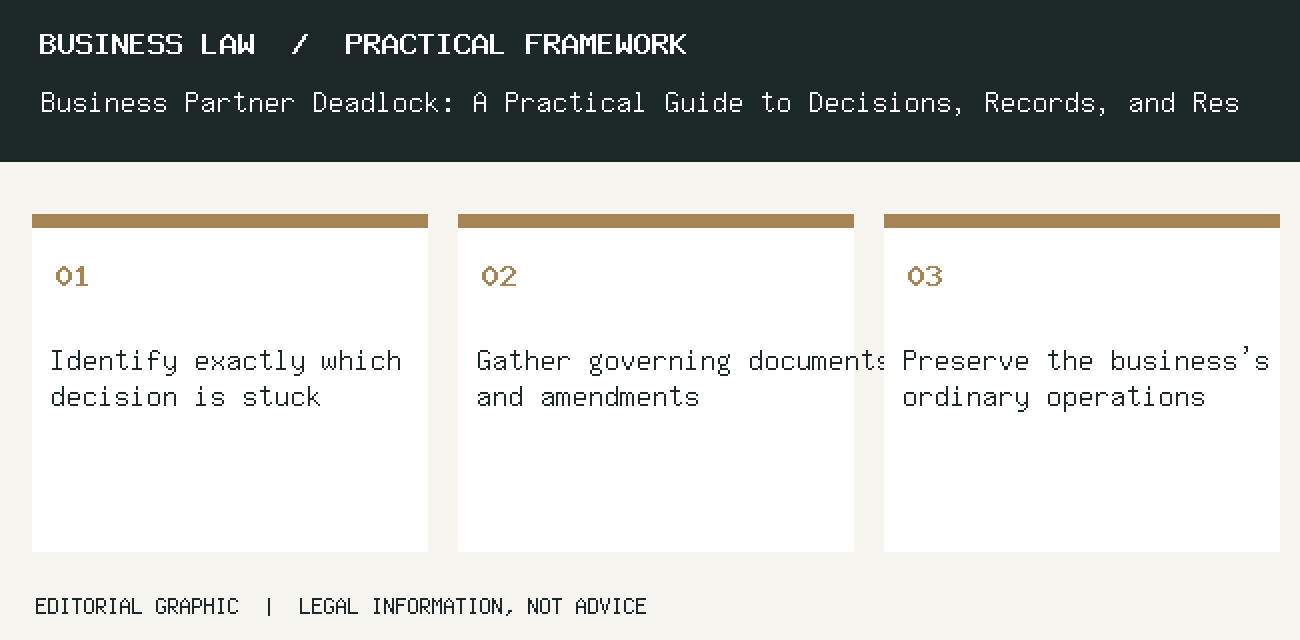
Identify exactly which decision is stuck
Owners may disagree about strategy while day-to-day authority continues; a true approval impasse can be narrower and more consequential. Consider what a reviewer unfamiliar with the relationship would need to verify this point. Identify the person responsible, the operative document, the relevant date and the practical impact. If the answer is uncertain, record precisely which additional fact or document could resolve it.
List the pending decision, deadline, required vote, proposed alternatives and the person authorized to execute each outcome. A governing document should be read together with the later record of conduct, without assuming that conduct always alters the written rule. Collect executed agreements and amendments first, then compare them against emails, approvals and the actual flow of money. A disciplined comparison is more useful than selecting one document that supports a preferred position.
Two equal owners may agree that an employee must be hired but disagree over compensation or who supervises the role. In a real disagreement, ask which document establishes the underlying obligation, who had authority to act, whether the timeline is agreed, and how a neutral third party could verify the claimed effect. Preserve any competing explanation alongside the supporting evidence.
Do not announce that a company is legally paralyzed before reviewing its governance rules. A useful next step is to identify the decision owner and deadline while keeping factual assertions carefully documented. Commercial urgency can justify attention, but it does not eliminate contractual requirements, confidentiality duties or the need to understand likely consequences.
Gather governing documents and amendments
Operating agreements, bylaws, shareholder agreements and later written changes may allocate powers differently from informal expectations. The written record should separate an original obligation from a later negotiation. That difference matters when deciding whether a requested action is mandatory, optional or still disputed. Do not quietly replace an earlier version; label amendments and preserve the chronology.
Find executed versions, capitalization records, board minutes, consent requirements, buy-sell terms and dispute procedures. The commercial consequence can be larger than the disputed invoice. Delayed decisions may affect customers, staff, confidential information, financing or vendor relationships. List those effects separately from legal damages; they may shape negotiation priorities without automatically becoming amounts recoverable in court.
An LLC manager might possess authority over routine vendors even though major borrowing requires member consent. Preserve any competing explanation alongside the supporting evidence.
Do not assume the loudest owner or largest investor controls every question.
Preserve the business’s ordinary operations
A deadlock can harm employees and customers even if the owners are primarily focused on each other. Use a short decision log rather than relying on scattered recollections. The log can identify the issue, available options, responsible person, evidence and next date for review. It gives management continuity when several people are involved.
Separate essential payroll, taxes, insurance, customer delivery and regulated obligations from discretionary projects. A practical review should explain what is established, what is merely alleged and what evidence would change the assessment. Create a working table with columns for the proposition, source, competing explanation and unresolved question. This makes legal advice and business planning more focused.
A contentious expansion vote should not obscure an uncontested obligation to maintain insurance for ongoing operations. Preserve any competing explanation alongside the supporting evidence.
Avoid unilateral actions that violate governance rules merely because a deadline feels urgent.
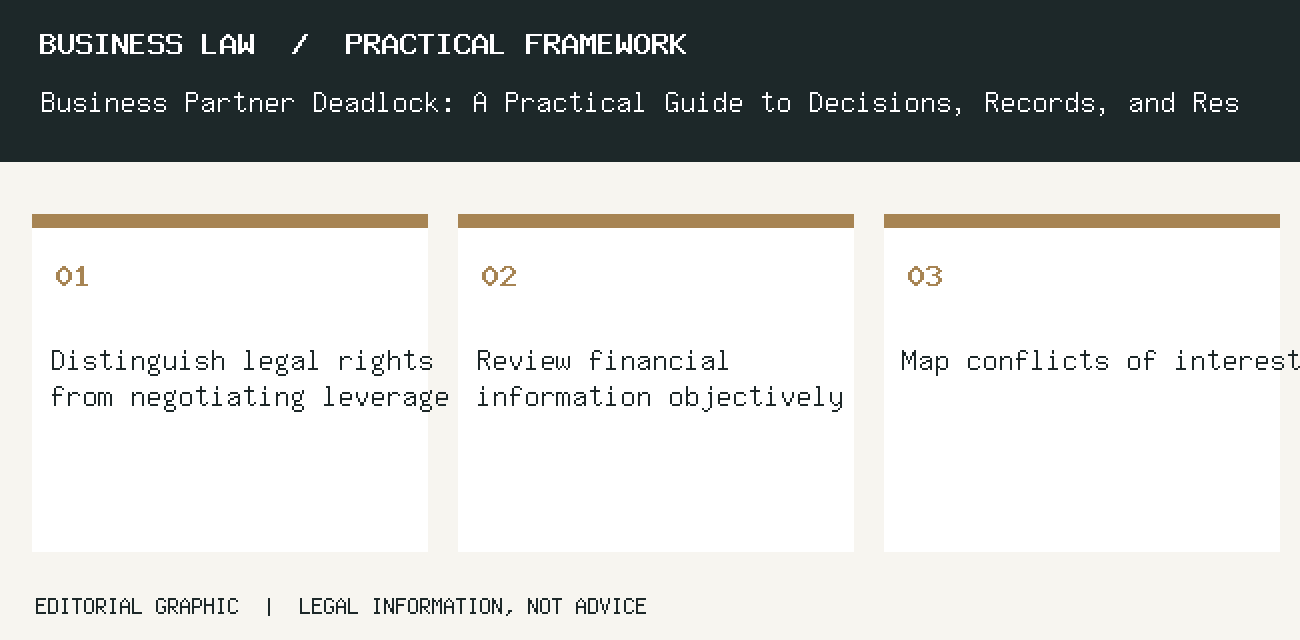
Distinguish legal rights from negotiating leverage
A partner’s practical bargaining power may not match a contractual veto or statutory management right. The relevant business question is how this affects performance, money, control or relationships, and which facts support that conclusion. A focused response is usually easier to evaluate than one that mixes every grievance into a single demand.
Write down which outcomes depend on unanimous approval, majority approval, manager authority or independent consent. Business owners may prefer a fast answer, but decisions such as termination, public accusations, account lockouts or release signatures can be difficult to reverse. Identify the governing approval and notice rules before acting. Meanwhile, assign immediate operational safeguards that do not require taking an unsupported legal position.
A 50 percent owner may feel entitled to sign a deal alone despite a provision requiring two signatures. Preserve any competing explanation alongside the supporting evidence.
Do not frame a strong business preference as a documented legal entitlement without support.
Review financial information objectively
Owners often lose trust when cash balances, related-party transactions or revenue assumptions are not transparent.
Reconcile bank statements, accounts, vendor commitments, loans, owner distributions and financial reporting periods. Documents should be maintained in a way that preserves context. Keep original files, unedited email chains and relevant metadata where feasible. A neat presentation copy is useful, but it should trace back to authentic source material and make assumptions clear.
A disagreement over distributions could reflect different forecasts rather than wrongdoing by either partner. Preserve any competing explanation alongside the supporting evidence.
Do not accuse another owner of misappropriation based solely on missing context in a report.
Map conflicts of interest
The dispute may involve compensation, competing ventures, family businesses or transactions with an owner-controlled supplier.
Identify interested persons, disclosures, approvals and whether an independent decision-maker is appropriate. Risk analysis is not the same as predicting a verdict. The available claims, defenses, documents, costs, deadlines and likely business disruption should be evaluated together. A discussion with counsel can prioritize the next decision even when a final legal outcome cannot yet be known.
A founder recommending their own consulting company as a vendor presents different questions from a neutral supplier review. Preserve any competing explanation alongside the supporting evidence.
Do not presume that every related-party transaction is prohibited, or that disclosure cures every problem.
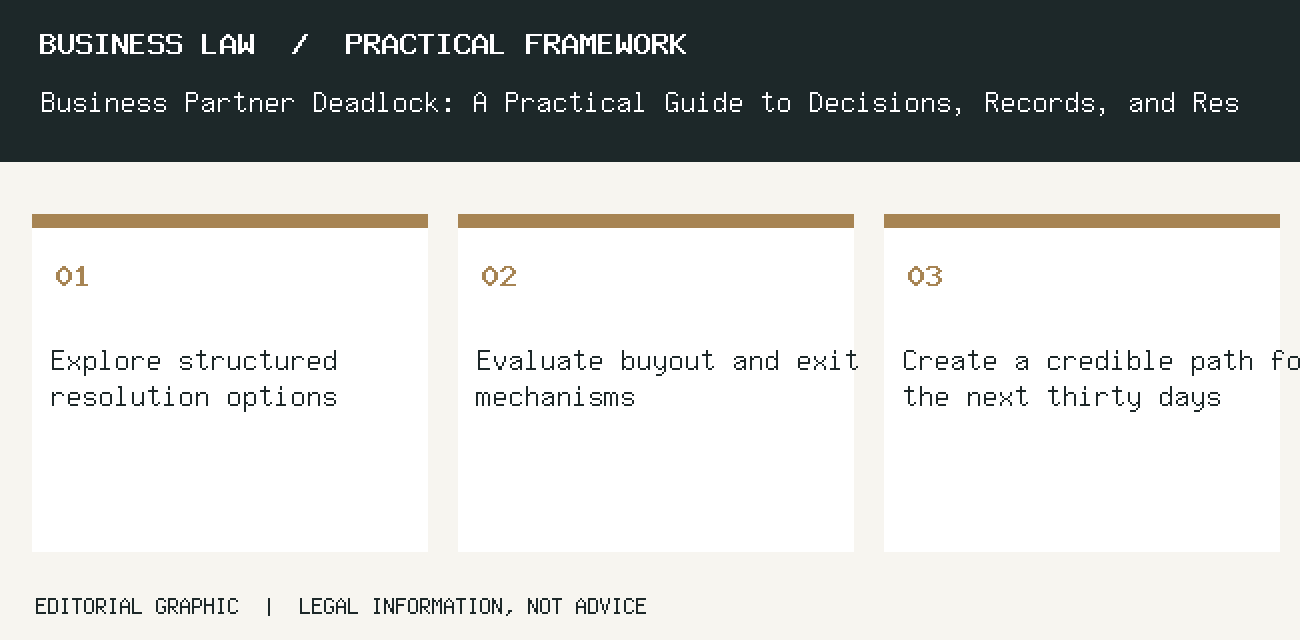
Explore structured resolution options
A deliberate conversation can sometimes resolve governance disputes without immediate public litigation.
Consider a documented agenda, neutral facilitation, mediation or a contract-specified escalation mechanism. Contractual notice processes matter because a sound commercial complaint may still face avoidable procedural objections. Check addresses, recipients, delivery methods and response periods in the actual operative agreement. Record when the communication was sent and received.
Partners may agree on temporary budgets and reporting rules while negotiating a longer-term ownership solution. Preserve any competing explanation alongside the supporting evidence.
Avoid informal promises that contradict written documents or unintentionally waive unresolved rights.
Evaluate buyout and exit mechanisms
If the relationship cannot continue, the parties may consider transfers, buyouts, valuations or winding down.
Review transfer restrictions, valuation definitions, payment terms, tax issues, debt guarantees and confidentiality expectations. An internal owner for each issue helps ensure that requests for information do not disappear between departments. Financial questions may belong with accounting, system-access questions with operations, and governance issues with responsible leadership. Consolidate the results into a single decision record.
A buyout price without a method for valuing inventory and contingent liabilities may create another dispute. Preserve any competing explanation alongside the supporting evidence.
Do not assume a simple handshake exit also releases personal guarantees or duties to third parties.
Create a credible path for the next thirty days
The most useful result of an initial review is often an agreed list of decisions and deadlines, not an instant final judgment.
Develop a decision matrix, temporary authority plan, financial information requests, and calendar for legal review. Before resolving a dispute, determine what completion will mean: who acts, by when, what documents or payments change hands, and how both parties verify performance. Ambiguous closing terms are a common source of renewed disagreement.
A founder team may preserve customer service while counsel assesses notice, voting and negotiated exit possibilities. Preserve any competing explanation alongside the supporting evidence.
Do not confuse a practical interim arrangement with a final resolution of all claims.
A nine-point working checklist
- Identify exactly which decision is stuck: List the pending decision, deadline, required vote, proposed alternatives and the person authorized to execute each outcome.
- Gather governing documents and amendments: Find executed versions, capitalization records, board minutes, consent requirements, buy-sell terms and dispute procedures.
- Preserve the business’s ordinary operations: Separate essential payroll, taxes, insurance, customer delivery and regulated obligations from discretionary projects.
- Distinguish legal rights from negotiating leverage: Write down which outcomes depend on unanimous approval, majority approval, manager authority or independent consent.
- Review financial information objectively: Reconcile bank statements, accounts, vendor commitments, loans, owner distributions and financial reporting periods.
- Map conflicts of interest: Identify interested persons, disclosures, approvals and whether an independent decision-maker is appropriate.
- Explore structured resolution options: Consider a documented agenda, neutral facilitation, mediation or a contract-specified escalation mechanism.
- Evaluate buyout and exit mechanisms: Review transfer restrictions, valuation definitions, payment terms, tax issues, debt guarantees and confidentiality expectations.
- Create a credible path for the next thirty days: Develop a decision matrix, temporary authority plan, financial information requests, and calendar for legal review.

Common questions
Can one partner force a buyout?
It depends on the company’s governing documents and applicable law. There is no universal automatic exit right. The correct response depends on the actual agreement, evidence, relevant law and procedural deadlines; tailored professional advice is appropriate before acting.
Should business operations stop during a deadlock?
Often the more urgent question is which actions are authorized and necessary to protect the enterprise.
Is mediation useful for founders?
It can be, particularly when communication has broken down but commercial solutions remain possible.
What documents matter first?
The executed governance documents, ownership records, decision history and current financial information.
Explore related legal services
- Business and corporate counsel
- Contract review and outside general counsel
- Commercial dispute resolution
- Contact AW Business Law
Official reference: California Secretary of State business entities.
This is general legal information, not legal advice, a promise of a particular outcome or an attorney-client engagement. The right approach depends on your business, contracts and applicable law.
Get clarity on your next business decision
Contracts, ownership decisions and commercial disagreements deserve careful, practical legal attention. Speak with counsel about your situation.