
Ending a Commercial Contract Without Losing Control of the Transition
Ending a Commercial Contract Without Losing Control of the Transition: business and legal information.
A business contract may be approaching its natural end, or performance problems may make an early exit attractive. But termination is not just a date on a letter. It can affect customer access, licensed technology, employees, confidentiality obligations, data ownership, inventory, payment and future claims. A sound exit plan treats legal rights and day-to-day operations as connected questions rather than separate projects.
Reader’s roadmap: The following sections identify the business problem, practical records to gather, possible options and caution points. They are general educational guidance and cannot determine the legal outcome of an individual matter.
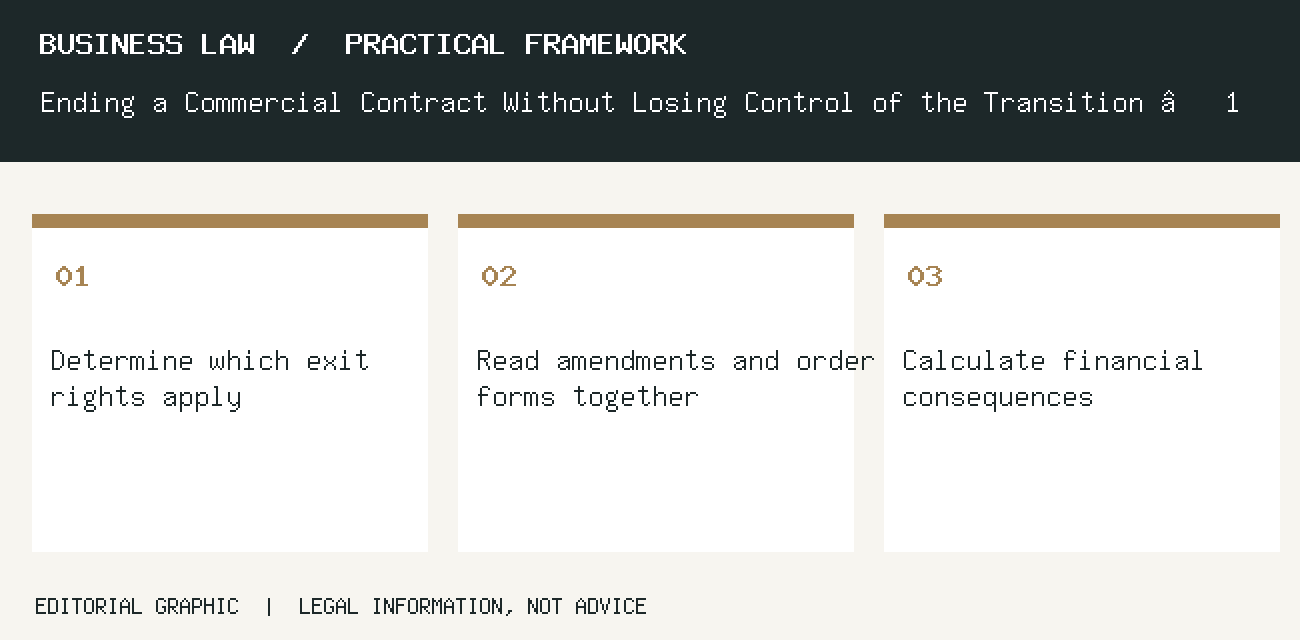
Determine which exit rights apply
An agreement may permit expiration, non-renewal, termination for convenience, termination for cause or termination after a cure period. Consider what a reviewer unfamiliar with the relationship would need to verify this point. Identify the person responsible, the operative document, the relevant date and the practical impact. If the answer is uncertain, record precisely which additional fact or document could resolve it.
Find the precise clause, conditions, notice methods, effective date and any continuing duties. A governing document should be read together with the later record of conduct, without assuming that conduct always alters the written rule. Collect executed agreements and amendments first, then compare them against emails, approvals and the actual flow of money. A disciplined comparison is more useful than selecting one document that supports a preferred position.
A contract may require a 60-day non-renewal notice but allow a separate breach-based termination process. In a real disagreement, ask which document establishes the underlying obligation, who had authority to act, whether the timeline is agreed, and how a neutral third party could verify the claimed effect. Preserve any competing explanation alongside the supporting evidence.
Do not assume cancellation on a website portal replaces the contractual notification requirements. A useful next step is to identify the decision owner and deadline while keeping factual assertions carefully documented. Commercial urgency can justify attention, but it does not eliminate contractual requirements, confidentiality duties or the need to understand likely consequences.
Read amendments and order forms together
A master agreement, annual order, data-processing addendum and change order may have different terms or end dates. The written record should separate an original obligation from a later negotiation. That difference matters when deciding whether a requested action is mandatory, optional or still disputed. Do not quietly replace an earlier version; label amendments and preserve the chronology.
Build a contract map of all documents and identify controlling language if provisions conflict. The commercial consequence can be larger than the disputed invoice. Delayed decisions may affect customers, staff, confidential information, financing or vendor relationships. List those effects separately from legal damages; they may shape negotiation priorities without automatically becoming amounts recoverable in court.
An add-on service signed later may have a separate minimum commitment even after the main subscription expires. Preserve any competing explanation alongside the supporting evidence.
Avoid relying on the original signature page when later amendments changed the relevant terms.
Calculate financial consequences
Early termination can trigger remaining fees, prepaid amounts, volume discounts, transition charges or disputes over work in progress. Use a short decision log rather than relying on scattered recollections. The log can identify the issue, available options, responsible person, evidence and next date for review. It gives management continuity when several people are involved.
Reconcile deposits, credits, minimum commitments, unpaid invoices and possible contractual charges. A practical review should explain what is established, what is merely alleged and what evidence would change the assessment. Create a working table with columns for the proposition, source, competing explanation and unresolved question. This makes legal advice and business planning more focused.
A vendor may agree to waive a fee only if the customer completes a transition by a defined date. Preserve any competing explanation alongside the supporting evidence.
Do not treat a gross balance as the final settlement without documenting the components.
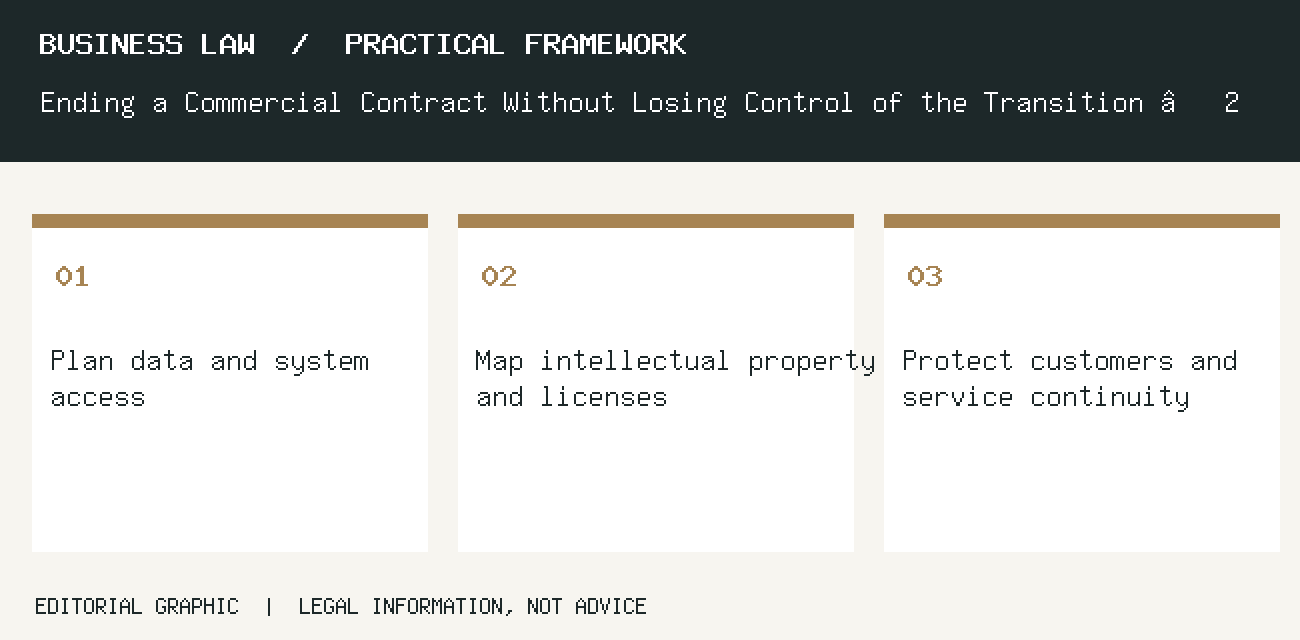
Plan data and system access
Modern business contracts often control crucial records, customer histories, integrations and administrator permissions. The relevant business question is how this affects performance, money, control or relationships, and which facts support that conclusion. A focused response is usually easier to evaluate than one that mixes every grievance into a single demand.
Inventory systems, export formats, authorized users, retention periods, credentials and any legal holds. Business owners may prefer a fast answer, but decisions such as termination, public accusations, account lockouts or release signatures can be difficult to reverse. Identify the governing approval and notice rules before acting. Meanwhile, assign immediate operational safeguards that do not require taking an unsupported legal position.
A CRM vendor transition may require a tested export of historical notes, attachments and consent records. Preserve any competing explanation alongside the supporting evidence.
Do not delete accounts before verifying that legally required records are retained and accessible.
Map intellectual property and licenses
Ownership of custom deliverables may differ from rights in proprietary software, stock assets or pre-existing methods.
Review assignments, license scope, third-party restrictions, source files and post-termination use rights. Documents should be maintained in a way that preserves context. Keep original files, unedited email chains and relevant metadata where feasible. A neat presentation copy is useful, but it should trace back to authentic source material and make assumptions clear.
A website handover can include the design files but not automatically transfer every paid font or plugin subscription. Preserve any competing explanation alongside the supporting evidence.
Avoid assuming possession of a download grants unlimited re-use rights.
Protect customers and service continuity
Termination can interrupt billing, support, security monitoring or service delivery if replacement arrangements are late.
Create a dependency map for active customers, vendor handoffs, support channels and critical dates. Risk analysis is not the same as predicting a verdict. The available claims, defenses, documents, costs, deadlines and likely business disruption should be evaluated together. A discussion with counsel can prioritize the next decision even when a final legal outcome cannot yet be known.
A managed IT contract might cover backups or security alerts that require uninterrupted replacement coverage. Preserve any competing explanation alongside the supporting evidence.
Do not announce a new provider before confirming service and compliance transitions are workable.
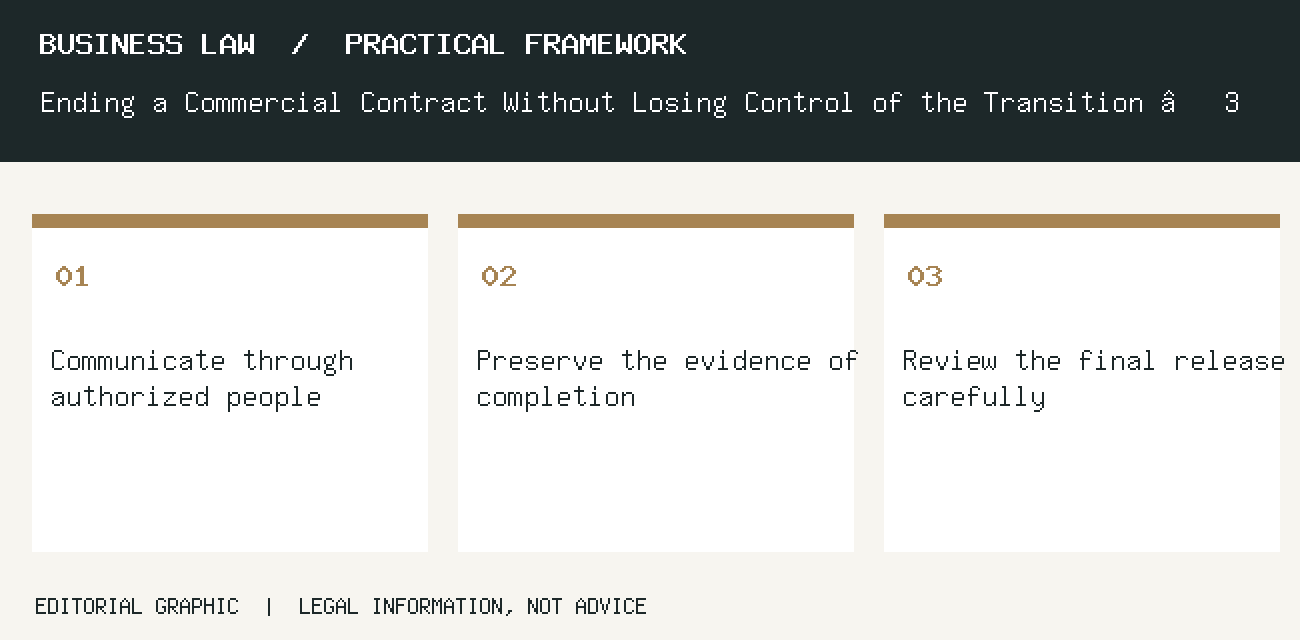
Communicate through authorized people
Informal emails from several departments may contradict the agreed exit position or confuse a supplier.
Designate a notice signatory and an operational handover coordinator with clearly limited roles. Contractual notice processes matter because a sound commercial complaint may still face avoidable procedural objections. Check addresses, recipients, delivery methods and response periods in the actual operative agreement. Record when the communication was sent and received.
Legal counsel may send the formal notice while operations schedules data transfer and final access. Preserve any competing explanation alongside the supporting evidence.
Avoid suggesting that operational cooperation means all legal claims have been released.
Preserve the evidence of completion
After a relationship ends, disputes may arise over whether data was returned, equipment collected or access disabled.
Use dated inventories, transfer receipts, meeting records, ticket closures and written acceptance of completed steps. An internal owner for each issue helps ensure that requests for information do not disappear between departments. Financial questions may belong with accounting, system-access questions with operations, and governance issues with responsible leadership. Consolidate the results into a single decision record.
A signed inventory may establish hardware return without resolving a disagreement about remaining fees. Preserve any competing explanation alongside the supporting evidence.
Do not erase historic logs or email correspondence simply because the contract has ended.
Review the final release carefully
Mutual releases, non-disparagement, confidentiality and non-solicitation language can have broader effects than expected.
Define which claims, parties, periods and exceptions the settlement covers; confirm who may sign. Before resolving a dispute, determine what completion will mean: who acts, by when, what documents or payments change hands, and how both parties verify performance. Ambiguous closing terms are a common source of renewed disagreement.
A short termination agreement may unintentionally include affiliates or future claims outside the intended deal. Preserve any competing explanation alongside the supporting evidence.
Do not exchange essential operational passwords for a waiver without appropriate security and legal advice.
A nine-point working checklist
- Determine which exit rights apply: Find the precise clause, conditions, notice methods, effective date and any continuing duties.
- Read amendments and order forms together: Build a contract map of all documents and identify controlling language if provisions conflict.
- Calculate financial consequences: Reconcile deposits, credits, minimum commitments, unpaid invoices and possible contractual charges.
- Plan data and system access: Inventory systems, export formats, authorized users, retention periods, credentials and any legal holds.
- Map intellectual property and licenses: Review assignments, license scope, third-party restrictions, source files and post-termination use rights.
- Protect customers and service continuity: Create a dependency map for active customers, vendor handoffs, support channels and critical dates.
- Communicate through authorized people: Designate a notice signatory and an operational handover coordinator with clearly limited roles.
- Preserve the evidence of completion: Use dated inventories, transfer receipts, meeting records, ticket closures and written acceptance of completed steps.
- Review the final release carefully: Define which claims, parties, periods and exceptions the settlement covers; confirm who may sign.

Common questions
Can a business terminate a vendor at any time?
Not necessarily. Contractual rights, notice and cure terms, and law may restrict an early exit. The correct response depends on the actual agreement, evidence, relevant law and procedural deadlines; tailored professional advice is appropriate before acting.
What records should survive termination?
Keep the executed contract, notices, invoices, approvals, transfer receipts and records subject to retention duties.
Who owns data at the end of a contract?
Rights depend on the agreement, data types, applicable law and third-party obligations.
Is non-renewal different from termination for breach?
Yes. They may involve different contractual triggers and consequences.
Explore related legal services
- Business and corporate counsel
- Contract review and outside general counsel
- Commercial dispute resolution
- Contact AW Business Law
Official reference: California Courts breach of contract overview.
This is general legal information, not legal advice, a promise of a particular outcome or an attorney-client engagement. The right approach depends on your business, contracts and applicable law.
Get clarity on your next business decision
Contracts, ownership decisions and commercial disagreements deserve careful, practical legal attention. Speak with counsel about your situation.