
Commercial Dispute Mediation: How Business Leaders Can Prepare for a Productive Session
Commercial Dispute Mediation: How Business Leaders Can Prepare for a Productive Session: business and legal information.
Mediation gives parties an opportunity to explore resolution with a neutral facilitator, but the session is not automatically productive because everyone agreed to attend. Leaders need a clear picture of the disputed facts, negotiation authority, costs, operational constraints and alternatives. A useful preparation process protects the company’s daily business while making it easier to evaluate workable options. This article describes the materials and decisions to organize before a commercial mediation.
Reader’s roadmap: The following sections identify the business problem, practical records to gather, possible options and caution points. They are general educational guidance and cannot determine the legal outcome of an individual matter.
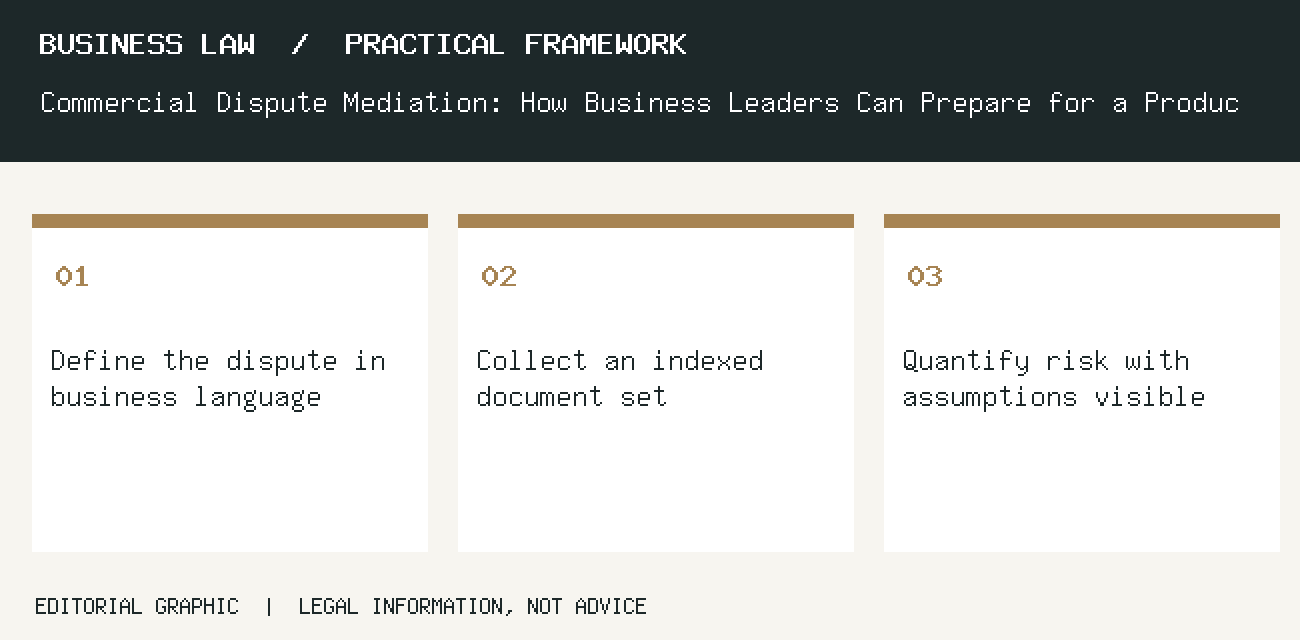
Define the dispute in business language
The legal pleadings may describe contract claims, but executives also need to understand customer impact and future operating concerns. Consider what a reviewer unfamiliar with the relationship would need to verify this point. Identify the person responsible, the operative document, the relevant date and the practical impact. If the answer is uncertain, record precisely which additional fact or document could resolve it.
Write a short factual overview of each contested event and the decisions a settlement would resolve. A governing document should be read together with the later record of conduct, without assuming that conduct always alters the written rule. Collect executed agreements and amendments first, then compare them against emails, approvals and the actual flow of money. A disciplined comparison is more useful than selecting one document that supports a preferred position.
A distribution dispute may be about missed deliveries today and exclusivity in next year’s sales territory. In a real disagreement, ask which document establishes the underlying obligation, who had authority to act, whether the timeline is agreed, and how a neutral third party could verify the claimed effect. Preserve any competing explanation alongside the supporting evidence.
Do not let a long accusations list obscure which outcomes would actually protect the company. A useful next step is to identify the decision owner and deadline while keeping factual assertions carefully documented. Commercial urgency can justify attention, but it does not eliminate contractual requirements, confidentiality duties or the need to understand likely consequences.
Collect an indexed document set
A mediator cannot usefully evaluate every raw email thread or financial file brought at the last minute. The written record should separate an original obligation from a later negotiation. That difference matters when deciding whether a requested action is mandatory, optional or still disputed. Do not quietly replace an earlier version; label amendments and preserve the chronology.
Prepare the signed agreement, key messages, invoices, timelines, expert summaries if any and a concise document index. The commercial consequence can be larger than the disputed invoice. Delayed decisions may affect customers, staff, confidential information, financing or vendor relationships. List those effects separately from legal damages; they may shape negotiation priorities without automatically becoming amounts recoverable in court.
A two-page chronology with links to the central documents may be more useful than a disorganized drive folder. Preserve any competing explanation alongside the supporting evidence.
Avoid selective excerpts that change the context of surrounding communication.
Quantify risk with assumptions visible
Settlement discussions improve when decision-makers know the difference between actual costs, estimates and best-case positions. Use a short decision log rather than relying on scattered recollections. The log can identify the issue, available options, responsible person, evidence and next date for review. It gives management continuity when several people are involved.
Build a range-based financial model with supporting inputs, anticipated litigation costs and business disruption. A practical review should explain what is established, what is merely alleged and what evidence would change the assessment. Create a working table with columns for the proposition, source, competing explanation and unresolved question. This makes legal advice and business planning more focused.
An anticipated lost margin should not be presented as booked revenue already earned. Preserve any competing explanation alongside the supporting evidence.
Do not represent an uncertain projection as a guaranteed court award.
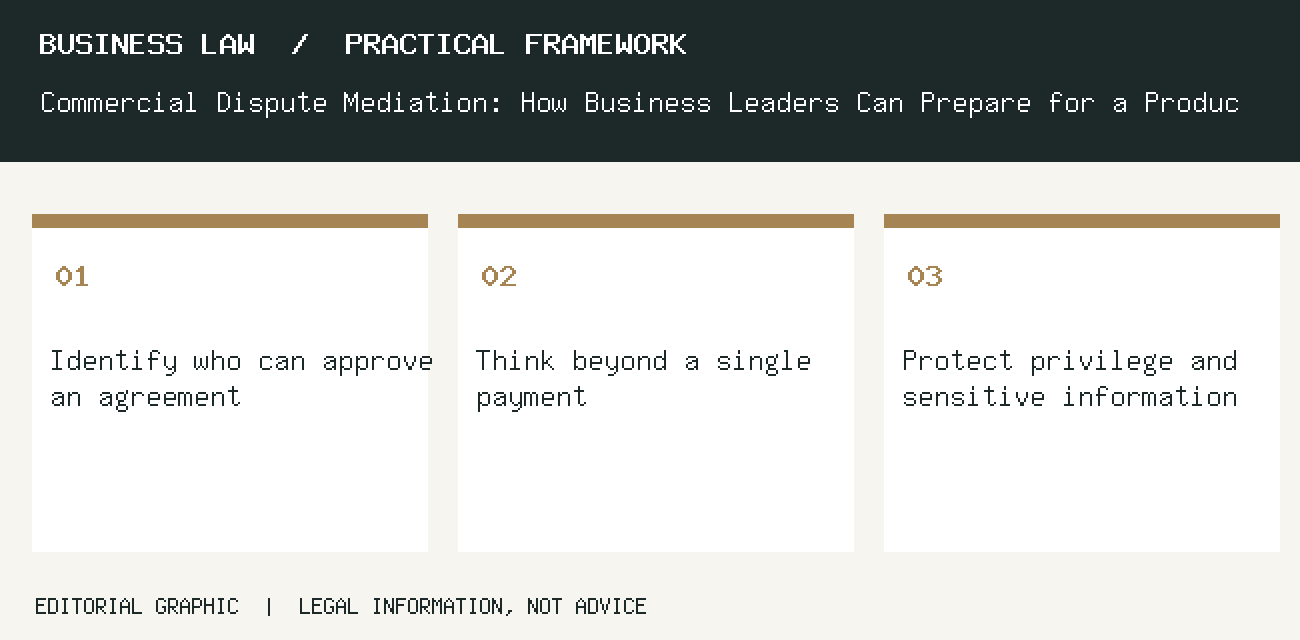
Identify who can approve an agreement
Mediation can stall if the person present lacks authority to negotiate or sign within the proposed range. The relevant business question is how this affects performance, money, control or relationships, and which facts support that conclusion. A focused response is usually easier to evaluate than one that mixes every grievance into a single demand.
Review board, manager, insurance and other approval requirements before the session. Business owners may prefer a fast answer, but decisions such as termination, public accusations, account lockouts or release signatures can be difficult to reverse. Identify the governing approval and notice rules before acting. Meanwhile, assign immediate operational safeguards that do not require taking an unsupported legal position.
A privately held company may need consent from owners for a restructuring even if a manager handles routine contracts. Preserve any competing explanation alongside the supporting evidence.
Avoid promising an immediate binding result where outside authorization remains necessary.
Think beyond a single payment
Commercial problems sometimes respond better to revised performance, scheduling, license rights or transition support than cash alone.
List nonfinancial terms that could address the source of friction, including future orders and confidential information. Documents should be maintained in a way that preserves context. Keep original files, unedited email chains and relevant metadata where feasible. A neat presentation copy is useful, but it should trace back to authentic source material and make assumptions clear.
A supply dispute might be resolved with substitute materials and a revised timetable. Preserve any competing explanation alongside the supporting evidence.
Do not accept complex ongoing obligations without considering how they would be monitored and enforced.
Protect privilege and sensitive information
Business records can contain customer data, trade secrets and internal advice that need deliberate handling.
Discuss with counsel what can be shared, how confidential submissions will work and which records should be limited. Risk analysis is not the same as predicting a verdict. The available claims, defenses, documents, costs, deadlines and likely business disruption should be evaluated together. A discussion with counsel can prioritize the next decision even when a final legal outcome cannot yet be known.
A valuation workbook may include unrelated financial details that do not need to circulate widely. Preserve any competing explanation alongside the supporting evidence.
Do not assume that every document shown to a mediator becomes protected from all later uses.
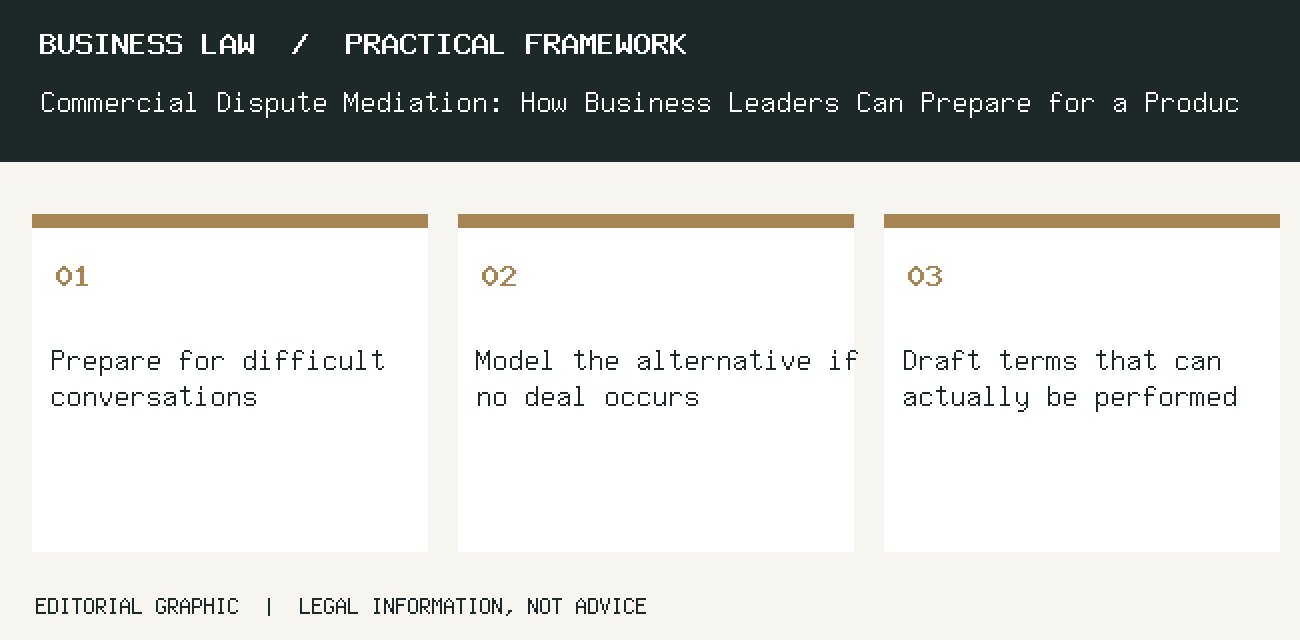
Prepare for difficult conversations
Participants may feel wronged, but the purpose is to test solutions rather than relitigate every frustrating exchange.
Assign a lead speaker, plan breaks and separate factual clarification from settlement bargaining. Contractual notice processes matter because a sound commercial complaint may still face avoidable procedural objections. Check addresses, recipients, delivery methods and response periods in the actual operative agreement. Record when the communication was sent and received.
An operations leader may explain practical delivery obstacles more clearly than a purely adversarial statement. Preserve any competing explanation alongside the supporting evidence.
Avoid personal attacks that make later business cooperation harder.
Model the alternative if no deal occurs
A rational agreement depends on the costs and risks of litigation, arbitration, continued disruption or an orderly exit.
Compare approximate process costs, uncertainty, management time and execution risk. An internal owner for each issue helps ensure that requests for information do not disappear between departments. Financial questions may belong with accounting, system-access questions with operations, and governance issues with responsible leadership. Consolidate the results into a single decision record.
An apparently favorable judgment may still require collection and enforcement efforts. Preserve any competing explanation alongside the supporting evidence.
Do not let sunk costs drive new spending without examining whether future value justifies it.
Draft terms that can actually be performed
A handshake number is insufficient if dates, tax issues, confidentiality and closing documents remain open.
Specify payment dates, actions, releases, defaults, confidentiality exceptions and responsibility for implementation. Before resolving a dispute, determine what completion will mean: who acts, by when, what documents or payments change hands, and how both parties verify performance. Ambiguous closing terms are a common source of renewed disagreement.
A settlement requiring system access should state when credentials are transferred and who verifies completion. Preserve any competing explanation alongside the supporting evidence.
Do not finish a mediation without identifying which material terms are still subject to agreement.
A nine-point working checklist
- Define the dispute in business language: Write a short factual overview of each contested event and the decisions a settlement would resolve.
- Collect an indexed document set: Prepare the signed agreement, key messages, invoices, timelines, expert summaries if any and a concise document index.
- Quantify risk with assumptions visible: Build a range-based financial model with supporting inputs, anticipated litigation costs and business disruption.
- Identify who can approve an agreement: Review board, manager, insurance and other approval requirements before the session.
- Think beyond a single payment: List nonfinancial terms that could address the source of friction, including future orders and confidential information.
- Protect privilege and sensitive information: Discuss with counsel what can be shared, how confidential submissions will work and which records should be limited.
- Prepare for difficult conversations: Assign a lead speaker, plan breaks and separate factual clarification from settlement bargaining.
- Model the alternative if no deal occurs: Compare approximate process costs, uncertainty, management time and execution risk.
- Draft terms that can actually be performed: Specify payment dates, actions, releases, defaults, confidentiality exceptions and responsibility for implementation.

Common questions
Is mediation binding?
Mediation is generally a process for negotiated resolution; the enforceability of any resulting agreement depends on its form and applicable law. The correct response depends on the actual agreement, evidence, relevant law and procedural deadlines; tailored professional advice is appropriate before acting.
Does the mediator decide who is right?
A mediator typically facilitates discussion rather than issuing a binding merits decision.
Can the business attend without a lawyer?
Representation choices depend on the case and procedure. Counsel can help identify legal and drafting risks.
What should the executive bring?
A chronology, document index, financial analysis, settlement objectives and clarity about decision-making authority.
Explore related legal services
- Business and corporate counsel
- Contract review and outside general counsel
- Commercial dispute resolution
- Contact AW Business Law
Official reference: California Courts small claims guide to mediation and arbitration clauses.
This is general legal information, not legal advice, a promise of a particular outcome or an attorney-client engagement. The right approach depends on your business, contracts and applicable law.
Get clarity on your next business decision
Contracts, ownership decisions and commercial disagreements deserve careful, practical legal attention. Speak with counsel about your situation.